Between body, object and place: exploring wicked wearables as active mediators in spatial transitions
Content
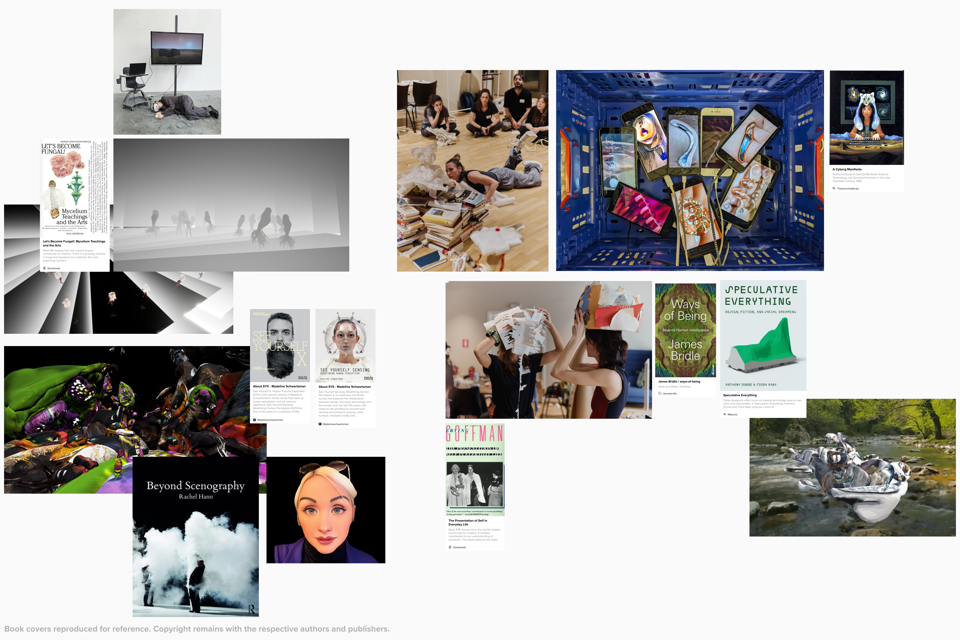
This Doctoral School activity (DS), an inter-university collaboration between Hasselt University, LUCA School of Arts, and PXL-MAD School of Arts, aims to explore wearables as technologies that can shift perception, initiate unexpected encounters, and open alternative relations between humans, environments, and more-than-human actors. This connects to Haraway’s notion of sympoiesis, or “making-with,” in which bodies and environments are formed through relation. Wearables are therefore not representations of more-than-human actors from the outside, but relational devices that help participants become attentive to the materials and ecological conditions that already shape a place.
Programme:-
12:30 - 13:00 welcome and intro (soup, coffee)
-
13:00 - 14:00 Lecture + Q&A: Rachel Hann
-
14:00 - 17:00 Workshop/roundtable conversation
-
17:00 - 18:00 coffee & mingle
Then a workshop/roundtable conversation is organised by Rachel Hann, Ioulia Marouda, Annellen Swillen, Guus Vandeweerd and Nikolas Kanavaris. During the workshop, participants will present wearable artefacts, performative objects… or other objects (physical, digital, or phygital) they have produced through or for their artistic and/or design practice. The curated session is intended as a space for collective reflection and peer feedback, with a particular focus on how these artefacts embody and reveal entanglements with more-than-human entities.
Overall scope
Bringing together perspectives from participatory design, urban planning, performance studies, critical costume, art jewellery, and more-than-human theory, this DS activity is meant to investigate how wearables can mediate and shift participation, identity, and relationships within shared environments. Building on performance theory, we approach identity not as stable or inherited, but as fluid, procedural, and continuously performed through material acts of appearance.
The DS is grounded in the idea that participation is not only verbal or cognitive, but also embodied and performative. In participatory action research, community art, eco-social design, and spatial practices, researchers and participants continuously “perform” roles through gestures, appearances, and material interactions. Clothing, costumes, jewellery, and portable objects are therefore understood not as neutral accessories, but as active mediators that shape how people enter, negotiate, and experience collective processes.
The activity develops analytical and conceptual thinking by encouraging participants to critically reflect on embodiment, appearance, and materiality within participatory research practices, while connecting perspectives from design, arts, jewellery, and urban planning. Through speculative and practice-based experimentation, participants strengthen creativity and innovativeness by developing alternative approaches to research communication and engagement, using wearable artefacts, performative methods, and the creation of a “Living Exhibit” for the REWORLDING exhibition on October 25-27, 2027.
Competences
An important part of preparing for any further professional step is becoming (more) aware of the competences you have developed and/or want to develop. In the current workshop, the following competences from the UHasselt competency overview are actively dealt with:
- intellectual competences
- analytical thinking
- creativity
- critical judgement
- interpersonal competences
- presentation skills
Practicalities
For whom?
- Participants will include PhD and Master’s students, designers, artists, and researchers working across these themes.
When and where?
- The workshop will take place on November 10, 2026 - 12:30 - 18:00
- PXL-MAD School of Arts, Hasselt (specific rooms TBC)
Registration?
- Registration is possible here until November 02, 2026
Acknowledged as?
- For participants attending both the Lecture and the workshop/roundtable conversation will help them broaden and deepen interdisciplinary research between the artistic and scientific fields presented.
- DS BSH: advanced discipline-specific knowledge - domain specific course
Collaborating team:
- drs. Nikolas Kanavaris, Prof. dr. Liesbeth Huybrechts (Hasselt University),
- drs. Guus Vandeweerd, dr. Anneleen Swillen (PXL-MAD School of Arts and Hasselt University),
- dr. Ioulia Marouda (Postdoctoral Researcher), Associate Professor Steven Malliet (LUCA School of Arts Campus Genk/C-Mine)