
VIENNA, Social Architecture and the Legacy of Red Vienna (Lecture 1)
Content
Swimming: A Daily Routine
Lecture by: Andreas Dvorak
The Second Workers’ Olympiad in Red Vienna, 1931
Swimming: A daily routine
“We don't benefit from having 40,000 people watching while 22 people are playing on the soccer field;
rather, we want those 40,000 spectators to be active themselves.”
Julius Tandler
During the period of Red Vienna (1919–1934), physical culture and sport occupied a significant position
within the political and social programme of the Austrian Social Democratic movement. Sport was not
understood merely as leisure or entertainment, but as an instrument of collective education, social
organisation, public health, and bodily discipline. Workers and young people were organised in clubs and
associations that promoted a conception of physical culture rooted in the idea of a Gesamt-Körperliches-
Konzept, a holistic understanding of the body in which education and collective well-being were closely
interconnected.
Architecture played a fundamental role in materializing this political understanding of the body. Public
swimming pools, sports fields and stadiums became part of a broader infrastructural project through
which the social-democratic city sought to transform everyday life. These spaces were designed not
simply to accommodate spectators but to facilitate mass participation and collective physical activity.
The construction of Vienna’s Praterstadion and Stadionbad in 1931, in preparation for the Second
Workers’ Olympiads opposed Pierre de Coubertin’s bourgeois Olympic Games, which were based on
rivalry between nations. In contrast, the Workers’ Olympiads emphasised internationalism, friendship and
solidarity.
The artistic attempt to draw the reconstructed Stadionbad emerged from a daily routine of swimming. It
raises questions about competitive sports and seeks an alternative in the (reconstructed) architecture of
the Stadionbad to the bourgeois logic of sport that has dominated its conception since 1945. The work
draws parallels between mainstream and counter-/subcultures and between the social structures of sport
and the bodily experience of being in the pool.
bio
Andreas Dvořák, born in Vienna, explores countercultural strategies and analyses parallels in the cooptation
of various subcultures, sports, art, and pop culture, that are connected to concepts of nationbuilding
and competition. His work focuses on designs intended to counter this logic and on those that
have helped shape the spatial appearance of the present.
His portraits encompass not only drawn and painterly elements but also performative, spaceencompassing
moments, which are reflected in the repetition of drawn lines. He studied at the Academy
of Fine Arts Vienna in the Contextual Painting class of Hans Ashley Scheirl and has been running the
label Fettkakao since 2005.
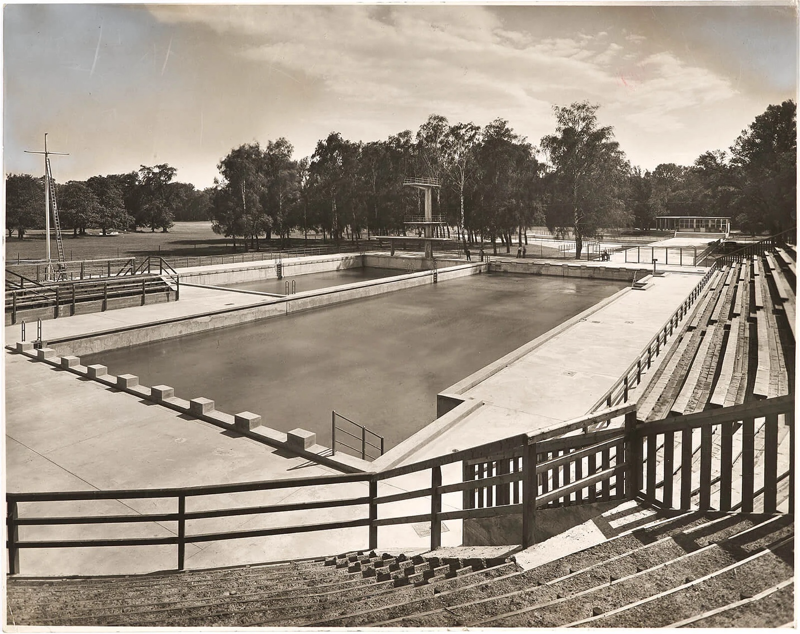
(Sportbecken) Prater - Stadionbad, um 1931, Foto: Martin Gerlach jun., Wien Museum Inv.-Nr. 20797
Practicalities
For whom?
- PhD students and postdocs
When and where?
- The lecture will take place on October 12, 2026 - 15:00-16:00
- Kapittelzaal H2/1.04
Registration?
- xxx