
Stijn Thomas
“An intervention must be the right intervention for the present, without setting things in stone for the future”
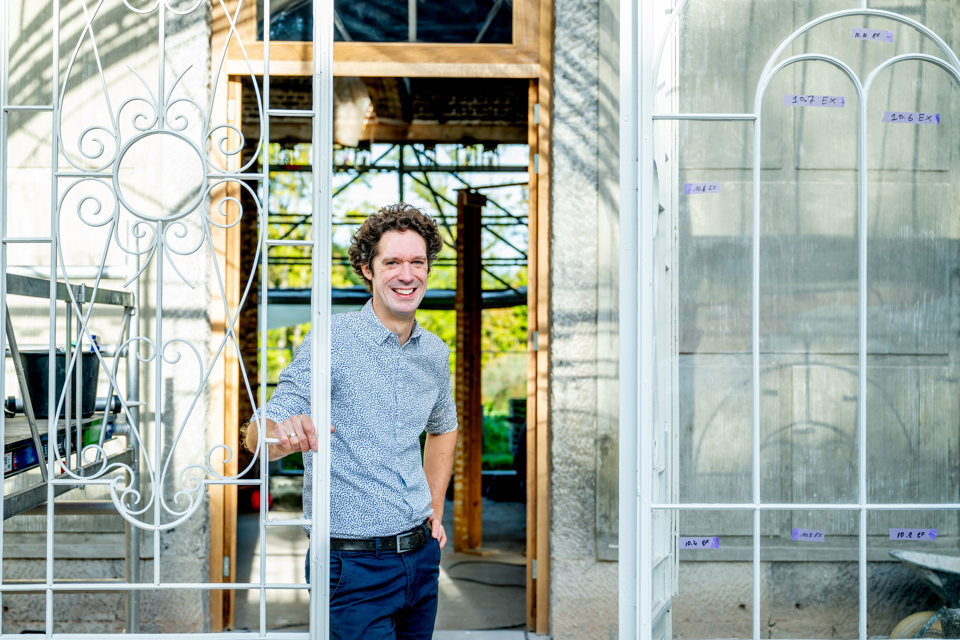
Many architects want to create, make their mark, leave a legacy. Stijn Thomas starts by listening to what is already there: old walls, hidden ceilings, traces of past lives. “As a heritage architect, you are a small part of a much greater whole. You try to understand a place’s essence and give history a future. The past is not past. And you get to add a chapter to it.”
Writing history
Some buildings change the way you see things forever. For Stijn Thomas, it came when he discovered Castello di Rivoli near Turin. As an architecture student, he observed how architect Andrea Bruno incorporated contemporary interventions without overshadowing the existing structure. “The new did not erase the old, but made it legible again.”
Since then, he believes that heritage does not require a return to the past; you need to build on what’s already there. “As an architect, you are part of a history that began long before you and will continue long after you.” In a hundred years from now, another architect might look at the same building, from a different perspective, and with different eyes. That’s how a building stays alive.”
Look before you start drawing
This requires restraint. Don’t start drawing right away; start by looking. Listening. Measuring. Analysing. Once you know what is there and what the essence of a place is, you can ask yourself what this place needs today. New functions, fire safety, accessibility, budgets: you need to consider everything.
For Thomas, constraints are never an obstacle. “It’s when you’re faced with constraints that creativity manifests itself. The more historical, technical, financial or legal constraints there are, the more interesting the quest becomes.” Heritage architecture is thus all about striking a balance: what to retain, what you can change, and how to add something without overshadowing what’s already there.
Unfinished past
Sometimes, a good design also means deliberately choosing not to solve a problem. Not every imperfection or intermediate stage needs smoothing over. “Over the centuries, buildings have been altered, expanded, and used in different ways. So why should we pick a single instant from this long history and freeze it in time forever?”, asks Thomas. “An intervention must be the right intervention for the present, without setting things in stone for the future.” Sometimes you simply need to press pause. With imperfections remaining visible. Because these traces are an indication that a place has lived.”
The architect out of the picutre
Thomas thinks a project is a success if people start using and experiencing a historic site again. “I love it when the architect fades into the background. When people walk in and think: of course that’s how it works. And nobody wonders who came up with the idea in the first place. That’s a good design.”
Short bio
STUDIES
-
1999-2004: Master of Architecture, UHasselt
-
2004-2006: Master of Conservation of Monuments and Sites, UHasselt
-
2009-2010: introduction to industrial archaeology, Flemish Association for Industrial Architecture
WERKERVARING
- 2004-2006: work placement, Team Herman van Meer Architecten
- 2007-2010: project architect, Team Herman van Meer Architecten
- 2011-2025: Partner and CEO, TeamvanMeer – Architecten en Co
- 2025-present: CEO, THOMAS X VAN MEER
10 questions for Thomas
After secondary school, I went on to study architecture because...
“I wanted to do more than just absorb and reproduce knowledge. I wanted to create something too. After the fourth year of secondary school, I switched to art school. Graphic design, advertising, product development: at first, I was fascinated by it all. But ultimately, an inspiring teacher guided me towards architecture. I found the combination of creativity and technique especially intriguing: devising something and actually building it.”
What made studying in Diepenbeek so special was…
“the welcoming campus in green surroundings, which was almost like a small community of its own. And the programme, of course, which focused on both design and technology. Architecture involves so much more than just drawing and making models.”
My favourite spot on campus was...
“the design studios, where everyone would pop in to admire each other’s work. You’d go in for a chat, look over other people’s shoulders, and learn from each other continuously.”
The teacher who inspired me the most was...
“actually, there were two. Guy Cleuren helped me hone my skills in the more practical subjects. Joris Capenberghs opened my eyes to heritage. He taught me to look at buildings from an architectural perspective, but also from an anthropological one: what is their significance? How did it change over time? And what are we doing with it today? This perspective still shapes my work today.”
As a student, I was…
“driven, curious, and passionate. I wanted to understand the world of architecture, find my way in it and, above all, get better at what I loved doing.”
If there’s one thing I learned at UHasselt (that I still use in my job today), it is…
“learning to look and think critically. In architecture, you learn to constantly question what you create. And you also learn to deal with criticism, even when you’re convinced that your idea is good. It can be a bit difficult at times, but in this line of work you have to dare to question yourself if you want to get ahead.”
How would you describe your job in no more than 5 sentences?
“Heritage architecture is incredibly fascinating and rewarding. You try to make a difference for people with interventions in the built environment. It is a creative profession, but at the same time it involves much more: technology, budgets, regulations, and administration are all part of the job. Surprisingly, it also involves a lot of communication. You can start the day on a construction site with a worker, meet with a mayor at noon, and sit down for a discussion with a lawyer in the afternoon. It’s all in a day’s work. “
What do you find most enjoyable / challenging about your job?
“No two days are the same. That’s what makes it fascinating, but sometimes it can also be quite challenging. To be honest, I enjoy the social aspect the most: you get to work with people who all have their own dreams, expectations, limitations and, in some cases, hidden agendas. Together, you need to create something beautiful. This takes constant dialogue, compromise, and balance, without giving up your own principles.”
In my opinion, the key to success lies in...
“never losing your sense of wonder and always questioning yourself. I still love it when something’s a success, even if it’s just a small detail. At the same time, I like to take a critical look at my past projects: what could I have done differently or better? There are things I did ten years ago that I’d do differently today. Which is fine. It means you keep growing.”
If you were able/want to do something or give back to your alma mater, what would it be?
“To pass on my passion for heritage architecture to young people.” To show that heritage isn’t old or outdated, but very relevant and fascinating. Students can always call me for plans, information or advice. I’m also happy to make time for a guest lecture. I’ve been very fortunate because, at crucial stages in my life, people showed me something, opened a door for me, or pointed me in the right direction. I’d be more than happy to do the same for someone else.”