OSCAR-BLINQ (2025-NOW)
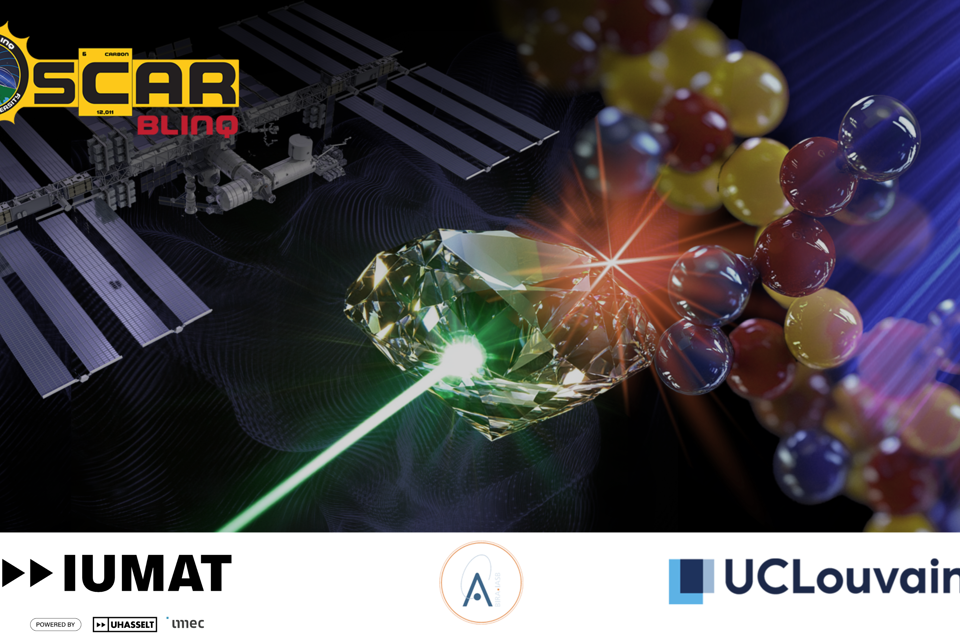
OSCAR-BLINQ works like an ultra-sensitive microscopic laboratory and uses these sensitive sensors to track chemical degradation by analyzing how light-sensitive molecules react to irradiation.
About the project
OSCAR-BLINQ is selected as the Belgian National Payload to accompany the next Belgian astronaut Raphaël Liégeois on his stay aboard the International Space Station. It is currently scheduled to launch in 2027 or 2028. The payload was officially selected by BELSPO (the Belgian Federal Science Policy Office). It is one of three flagship Belgian experiments chosen to accompany Liégeois during his 6-month stay in orbit to highlight national breakthroughs in quantum technology and astrochemistry. Once on board the ISS, the OSCAR-BLINQ hardware will be installed inside the ICE Cubes facility. This is a commercial research platform located inside Europe's Columbus laboratory module that provides power, data transfer, and real-time monitoring capabilities back to scientists on Earth.
BLINQ stands for Belgian Light-Induced astrochemistry study using (Nano)diamond-based Quantum sensors. The name comes from the fact that the OSCAR team uses their sensor as a platform to study chemical phenomena in space. “Light-induced” refers to the chemicals that have different properties under certain light conditions.
In this project we are making a new sensor to demonstrate diamond quantum sensing technology beyond its magnetometry application. This step in the OSCAR journey utilizes the sensor as a platform for a more advanced application - study of molecular kinetics in microgravity. The project is not only an advancement in terms of technology, but also interdisciplinarity.
While earlier iterations of the OSCAR series were designed to function as advanced magnetometers, OSCAR-BLINQ works more like an ultra-sensitive microscopic laboratory. Previous projects functioned as highly sensitive 3D magnetometers but OSCAR-BLINQ switches focus on using these sensitive sensors to track chemical degradation by analyzing how light-sensitive molecules react to irradiation.
Goals
The main goal of the project is to focus on understanding chemical processes in a weightlessness environment and how it differs from earth. The team will be measuring the creation of highly reactive molecules (free radicals) in real-time and recording how tiny chemical balance changes in space and comparing them to on-ground measurements. This will give an insight into astrochemistry and how organic molecules change when exposed to real intense solar radiation.
Results
The OSCAR team is currently wrapping up the critical design phase which means all their hardware is designed and concepts are verified and will soon start qualifying it to fly to the ISS.
The consortium behind the OSCAR-BLINQ project is a collaboration across Belgium between UHasselt (quantum sensing technology), BIRA-IASB (fundamental science) and UCLouvain (photochemistry).